

BERANDA MIGRAN POSITION STATEMENT:
INTERNATIONAL WORKERS’ DAY 2026, STRENGTHEN MIGRANT WORKERS AND RETURNEE MIGRANT WORKERS ORGANIZING, FIGHT BACK AGAINST REMITTANCE POLITICS AND GLOBAL EXPLOITATION
May Day 2026 is a moment to reaffirm that the struggle of Indonesian workers never stands alone, it grows from a collective experience of working in uncertainty, inhumane wages, and torturous working conditions. Solidarity became the foundation that unites workers across sectors, from factories to domestics, from villages to cities, from our homeland to overseas.
The challenges faced by Indonesian workers are getting complex and layered each day. Formally, the open unemployment rate is around 4.7-4.8% or about 7.3 million people, but this number fails to reflect the reality around us. Behind those are millions of workers that are trapped in no-contract jobs, part-time, internship, and informal sectors that offer no income security. Waves of layoffs continue, with over 80,000 cases throughout 2025, exposing how fragile the current labor structure really is. Meanwhile, 3-4% inflation keeps decreasing our purchasing power. We are nowhere near enough to cover the rising living cost with average wages under IDR 3 million per month.
At the same time, the workers’ collective power is also weakening. Union membership continues to decline and now covers only a small fraction of the workforce. Union busting practices, unstable contracts, fragmented labor sectors, and the expansion of the gig economy, they all make worker organizing even harder. As a result, many workers face pressure without adequate collective protection.
In this employment crisis, women are in the most vulnerable position. They are more often pushed into unprotected sectors, such as domestic and care work, which are rarely recognized as formal labor. The double burden of productive and reproductive labor deepens existing inequalities. When the job opportunities start to shrink, women will be the first to be pushed out of formal labor and end up filling the informal sector the most.
The informalization of labor is rapidly exploding as a response to the crisis, but not as a form of liberation. The informal sector is filled with more than half of Indonesia’s workforce, with many workers lacking formal contracts, social security, and legal protection. The gig economy, often marketed as “flexibility”, is merely a mask of uncertainty in work conditions, where all risks are shifted from the employer to the worker. In this state, work loses its essence as a livelihood and becomes a mere day-to-day survival mechanism.
In a broader context, this situation cannot be separated from a deepening global crisis, marked by war, geopolitical conflict, and international economic instability. U.S. interventions and imperialist blocs in Venezuela, Iran, and West Asia, alongside China’s expanding influence in the South China Sea, reflect escalating geopolitical tensions. Across the world, the rise of far-right politics, driven by xenophobia, racism, and anti-people rhetoric, goes hand in hand with increasing militarism and authoritarianism. States are relying more on coercive power to secure their economic and political interests.
Military and war budgets continue to rise at the expense of social security and working class protection, while taxation and inhumane exploitation deepen. In this situation, the working class, including migrant workers, are the hardest hit. Global crises don’t just create uncertainty, but also disrupt economic chains and shrink job markets, pushing massive labor migration from the Global South to global economic centers.
Instead of tackling the job crisis by strengthening labor protections, eradicating corruption, ending suffocating taxes, building national industrialization, and carrying out agrarian reform, the government is redirecting this pressure outward. The policy of sending Indonesian Migrant Workers is being intensified and even romanticized. The establishment of the Ministry of Migrant Worker Protection (KP2MI) reflects a stronger orientation toward exporting labor as a solution to unemployment and economic crisis. Programs like SMK Go Global confirm this trajectory: education is being geared to meetthe global labor market demand instead of building local economic independence.
At the same time, the rise of narrow nationalism, racism, and repressive immigration policies in destination countries are worsening migrant workers’ vulnerability. They are not only treated as cheap labor but also become an easy target for exploitation. Thus, migration is not just driven by domestic crises, it is a consequence of a global system that is unequal, exploitative, and increasingly militaristic.
Under this framework, our people are treated as commodities prepared for cross-border labor, while remittances are used as indicators of success. But behind those numbers lies a harsher truth, many are forced to leave their homeland because there are no decent job alternatives.
Behind the glorification of migrants as “Foreign Exchange Heroes” (Pahlawan Devisa) and the ridiculous slogan “Go a Migrant, Return a Boss” (Pergi Migran, Pulang Juragan), millions of migrant workers are enduring deeply exploitative conditions. Physical and sexual violence, underpaid or unpaid wages, excessive working hours without rest days, and inhumane working conditions are the daily realities, especially in domestic and care sectors. Indonesian migrant workers also face racism, discrimination, document withholding, overcharging, human trafficking, and even forced criminal labor (FCL) run by transnational organized crime networks.
This exploitation chain even starts long before departure. Recruitment brokers (calo) are still widespread, charging extremely high placement fees that force workers into debt from the start. This debt traps workers and weakens their bargaining position. Various forms of fraud such as document falsification and fake job promises continuously happen, often facilitated by the negligence or active involvement from officials who are supposed to provide protection.
In such conditions, migrant workers become subjects of multiple forms of exploitation: disguised forced labor, limitation from their freedom of movement, and even criminalization when they are trying to resist. Migration, in this context, can no longer be seen as a free choice, it is a form of forced migration, driven by employment crises, labor informalization, and domestic economic inequality.
Yet, despite these pressures, migrant workers continue to show extraordinary resilience. They are building cross-border solidarity networks, sharing information, protecting one another, and keep organizing despite the risks and repression. Through creative strategies, grassroots migrant organizations push advocacy and broader campaigns, refusing to stay silent, and they are demanding their rights to decent work and a dignified life.
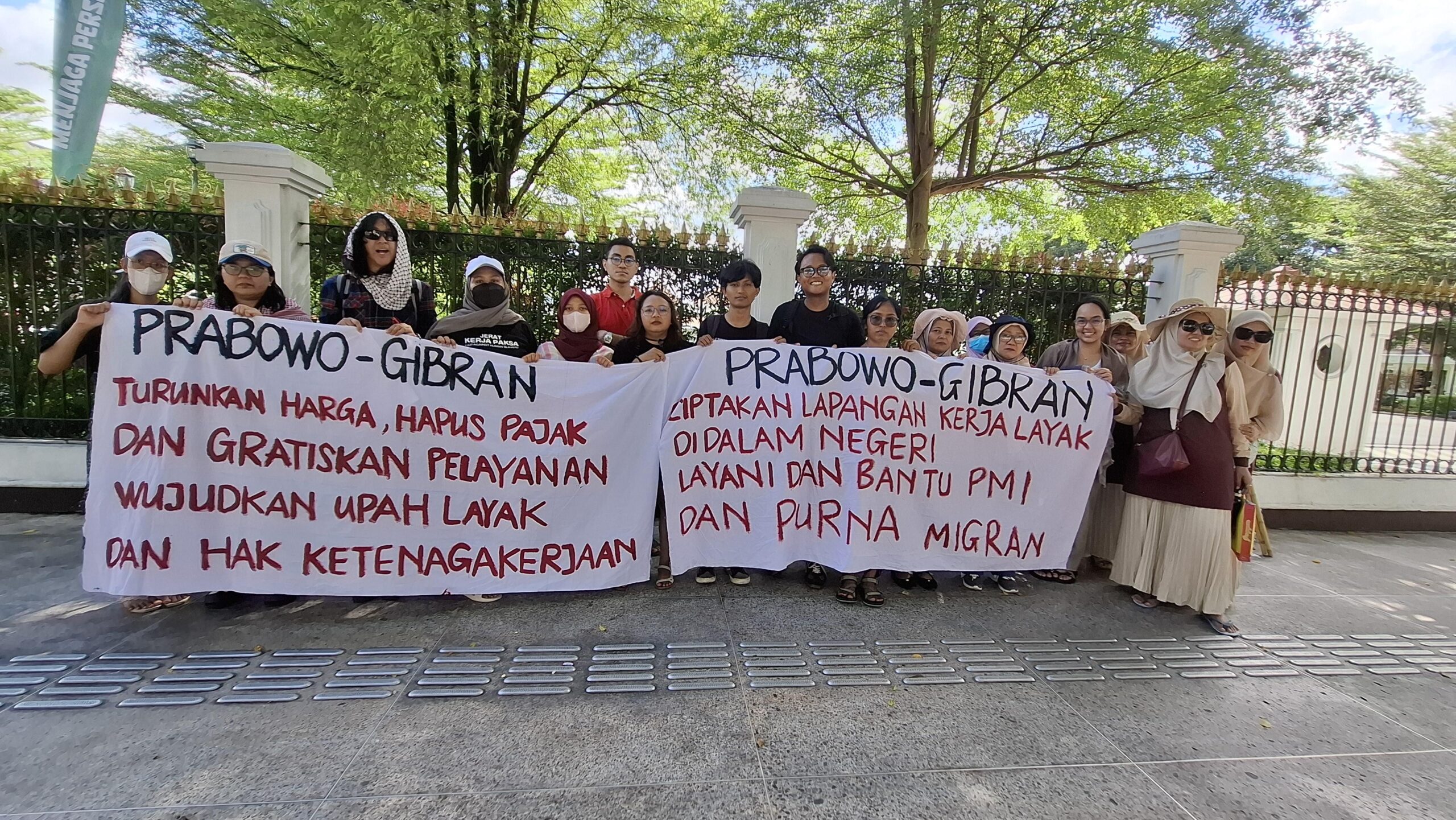
On this May Day 2026, Beranda Migran declares our firm solidarity with the working class, both those struggling at home and those forced to work abroad. We stand with migrant workers and all workers, rejecting conditions that force our people to leave their homes and families just to survive.
Long Live the Workers! Long Live Indonesian Migrant Workers! Long live the Peoples of Indonesia!
Contact Person: 0811-2645-522 — Hotline Beranda Migran
